Motion sensor stair lights have become a popular upgrade for modern homes and commercial spaces. They make going up and down stairs at night safer, more stylish, and energy efficient. But as more people install these lights, a common question comes up: Can motion sensor stair lights be dimmed? Many want more control over brightness, both for comfort and to match the mood or style of their space.
If you’ve ever walked up a staircase at night and been blinded by harsh lights, or if you simply want to make your home feel cozy and welcoming, you’ve probably wondered about dimming options. This article explores everything you need to know about dimming motion sensor stair lights.
We’ll look at how these lights work, which types can be dimmed, what to look for when shopping, and how to get the best results. Whether you’re planning a new install or want to upgrade your current setup, you’ll find clear advice and practical tips here.

Exclusive Deals
Limited-time Exclusive Deals. Check current discount on Amazon.
Check Price on Amazon As an Amazon Associate I earn from qualifying purchases.Understanding Motion Sensor Stair Lights
Motion sensor stair lights are designed to turn on automatically when they detect movement. This feature saves energy, increases safety, and adds convenience. Instead of fumbling for a switch, you just step onto the stairs and the lights come on.
How Motion Sensors Work
Most stair lights use passive infrared (PIR) sensors. These sensors detect the heat from moving bodies, like people or pets. Some use microwave sensors or ultrasonic sensors, but PIR is most common for home stair lighting.
Benefits Of Motion Sensor Stair Lights
- Hands-free activation: No need to touch switches.
- Energy savings: Lights only turn on when needed.
- Improved safety: Reduces risk of falls at night.
- Modern design: Adds a stylish touch to staircases.
Types Of Motion Sensor Stair Lights
- LED strip lights: Flexible strips installed along stair edges.
- Recessed step lights: Small fixtures built into each step or wall.
- Surface-mounted lights: Fixtures placed on the wall or stairs.
- Battery-powered or hardwired: Some run on batteries, others connect to household wiring.
Each type has its own features and installation requirements, which can affect dimming options.
Can Motion Sensor Stair Lights Be Dimmed?
The short answer is yes—many motion sensor stair lights can be dimmed, but not all. Whether dimming is possible depends on the light fixture, the sensor type, and the installation method.
Exclusive Deals
Limited-time Exclusive Deals. Check current discount on Amazon.
Check Price on Amazon As an Amazon Associate I earn from qualifying purchases.Dimmable Vs Non-dimmable Models
Some stair lights come with built-in dimming. Others need a compatible dimmer switch or controller. And some cannot be dimmed at all.
Here’s a quick comparison:
| Type | Dimmable? | How to Dim |
|---|---|---|
| LED Strip Lights | Usually | Controller, remote, or smart app |
| Recessed Step Lights | Sometimes | Wall dimmer switch or built-in control |
| Surface-Mounted Lights | Varies | Manual or smart controls |
| Battery-Powered Models | Rarely | Usually fixed brightness |
Key Requirements For Dimming
For a motion sensor stair light to be dimmable, you generally need:
Exclusive Deals
Limited-time Exclusive Deals. Check current discount on Amazon.
Check Price on Amazon As an Amazon Associate I earn from qualifying purchases.- Dimmable LED drivers or bulbs: Not all LEDs can dim. The driver (the electronic part that powers the light) must allow dimming.
- Compatible control: This could be a dimmer switch, remote, app, or a built-in dimming function.
- Sensor compatibility: The motion sensor must work with dimming. Some sensors only support on/off, not variable brightness.
Common Dimming Methods
- Physical dimmer switches: Installed on the wall, often used with hardwired lights.
- Remote controls: Some stair lights come with their own remote for adjusting brightness.
- Smartphone apps: If your lights are smart-enabled (WiFi or Bluetooth), you can control brightness through an app.
- Built-in buttons or touch controls: Some fixtures let you adjust brightness on the unit itself.
Types Of Dimmable Motion Sensor Stair Lights
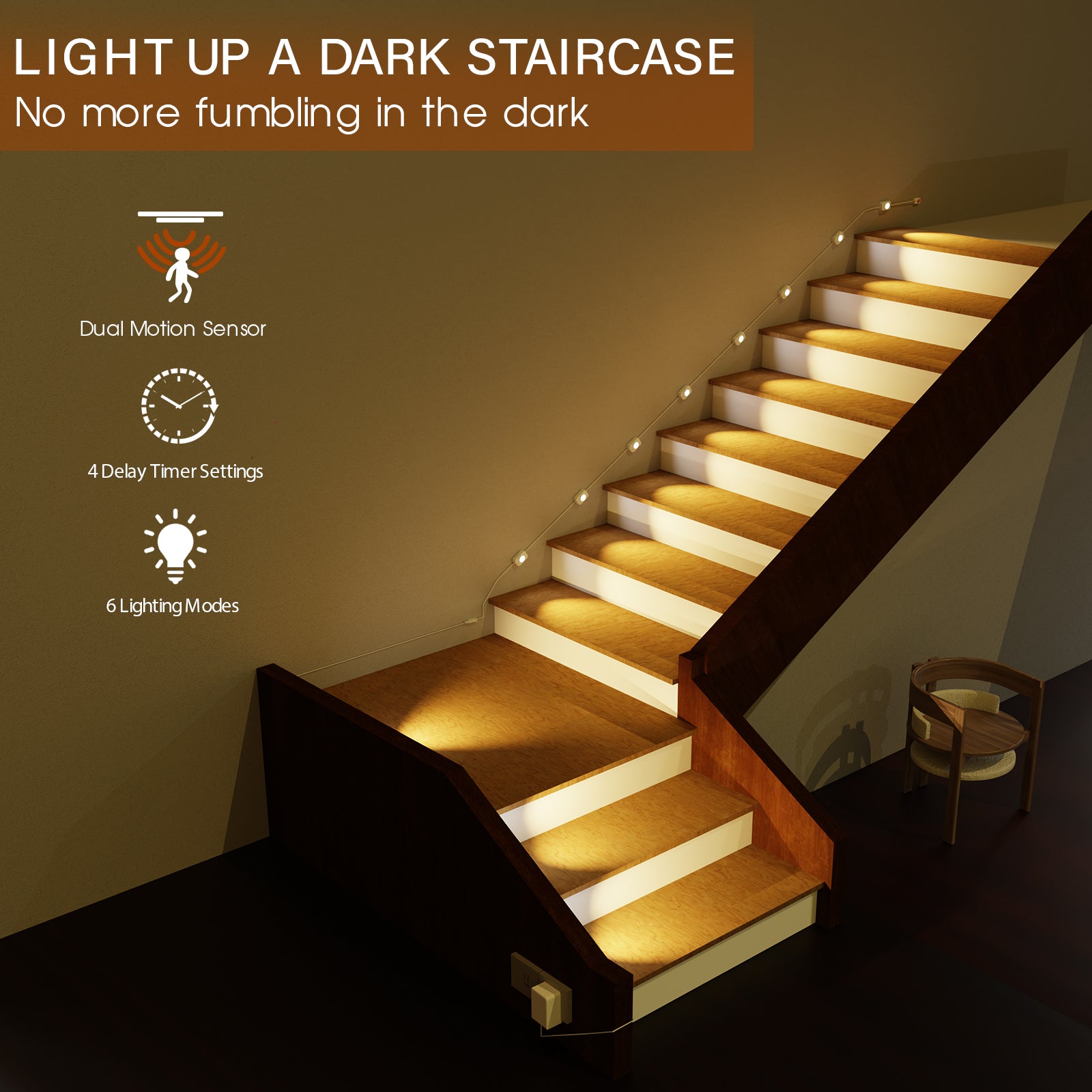
With so many products on the market, it can be hard to tell which lights offer dimming. Here’s a closer look at the main types you’ll find:
Dimmable Led Strip Stair Lights
LED strips are the most popular for stairs. Many models support dimming, especially if they’re designed for smart homes.
- Smart LED strips: Brands like Philips Hue and Govee offer strips that you can dim using an app or voice assistant.
- Manual dimmable strips: Some strips include a remote control or a small dimmer knob.
- Integrated motion and dimming: Higher-end systems let you set different brightness levels for day and night.
Dimmable Recessed Step Lights
These are small lights built into each step or beside the stairs.
- Hardwired models: If installed with a compatible dimmer switch, many can be dimmed.
- Integrated dimming: Some have their own dimming control, but this is less common.
Dimmable Surface-mounted Stair Lights
Often used for outdoor stairs or minimalist interiors.
- Smart models: Can be dimmed via app or smart home system.
- Manual adjustment: Some have sliders or buttons for dimming.
Battery-powered Motion Sensor Stair Lights
Most battery-powered models are not dimmable. They are designed for simplicity and energy savings. However, a few advanced models offer low/high brightness modes, usually toggled by a button.
| Light Type | Dimming Options | Typical Use |
|---|---|---|
| Smart LED Strip | App/voice/remote | Indoor, custom lighting |
| Recessed Step Light | Wall dimmer/manual | Modern stairs, permanent install |
| Battery Surface Light | Rarely | Quick install, rental homes |
How Dimming Works With Motion Sensors
Dimming and motion sensing are both useful, but combining them can be tricky. Here’s what you need to know:
Sensor And Dimmer Compatibility
- Standard dimmer switches: Work well with many wired LED stair lights, but only if both the sensor and light support dimming.
- Integrated sensor/dimmer units: Some stair light kits combine motion sensing and dimming in one controller.
- Smart home integration: With products like Philips Hue, you can set routines (dim at night, brighter in the evening) triggered by motion sensors.
Common Dimming Behaviors
- Full brightness on motion: Light turns on to 100% when motion is detected, then turns off.
- Adaptive dimming: Light turns on at a preset brightness (for example, 30% at night, 70% during the day).
- Fade in/out: Some systems smoothly ramp up or down, instead of switching instantly.
Some cheaper systems only allow on/off, while advanced ones let you fine-tune the brightness and transition speed.
Benefits Of Dimmable Motion Sensor Stair Lights
Adding dimming to motion sensor stair lights gives you many advantages:
- Comfort: Avoids harsh brightness, especially at night.
- Customization: Set different brightness for different times or moods.
- Energy savings: Lower brightness uses less power and extends LED lifespan.
- Safety: Soft lighting helps people see without being blinded.
- Style: Dimming lets you create an elegant look for parties or quiet evenings.
Potential Drawbacks And Limitations
While dimmable motion sensor stair lights are appealing, there are some challenges to consider:
Not All Systems Are Compatible
Mixing sensors, dimmers, and lights from different brands can cause problems. For example, a sensor might not send the right signal to a dimmable driver, or the dimmer could “fight” with the sensor, causing flickering.
Installation Complexity
Adding both motion sensors and dimming often means more wiring, programming, or setup. Some systems need a hub or smart home controller.
Cost
Dimmable and smart systems usually cost more than basic on/off models. Expect to pay extra for features like app control or adaptive brightness.
Limited Battery Options
If you need a battery-powered solution, your choices for dimming are limited. Most battery stair lights are fixed brightness to save power.

Choosing The Right Dimmable Motion Sensor Stair Light
When shopping for dimmable motion sensor stair lights, keep these points in mind:
What To Look For
- Dimmable rating: Check that both the LED and driver are marked “dimmable.”
- Compatible sensor: Make sure the motion sensor works with dimming (check the specs).
- Control method: Decide if you want a wall switch, remote, app, or smart home control.
- Installation needs: Hardwired systems are more flexible, but battery models are easier to install.
- Quality and reviews: Read user reviews and look for products from trusted brands.
Key Comparison Factors
| Feature | Wired Lights | Battery Lights |
|---|---|---|
| Dimming Options | Many choices | Few to none |
| Installation | Harder | Easy |
| Smart Control | Available | Rare |
| Cost | Higher | Lower |
| Brightness Levels | Customizable | Usually fixed |
Common Buyer Mistakes
- Assuming all LEDs are dimmable: Many cheap LEDs are not.
- Mixing incompatible parts: Not every sensor and dimmer will work together.
- Ignoring install complexity: Some systems need professional installation.
- Overlooking warranty and support: Choose brands that offer good support, especially for smart or hardwired systems.
How To Install And Set Up Dimmable Motion Sensor Stair Lights
If you decide to install dimmable motion sensor stair lights, here’s a step-by-step guide for most systems. Always follow manufacturer instructions and local electrical codes.
Step 1: Plan The Layout
- Measure your stairs.
- Decide where to place each light and the sensor(s).
- Plan power supply and wiring (if hardwired).
Step 2: Choose The Right Products
- Make sure lights and sensors are compatible and support dimming.
- Buy all necessary controllers, dimmers, or smart hubs.
Step 3: Install The Lights
- For wired systems: Turn off power, run wiring, mount fixtures, and connect to power.
- For battery systems: Install with adhesive or screws.
Step 4: Connect The Sensor And Dimmer
- Follow wiring diagrams carefully.
- For smart systems, connect to WiFi or Bluetooth and pair with the app.
Step 5: Test And Adjust
- Trigger the motion sensor and check if the lights turn on and dim correctly.
- Adjust brightness using your chosen method (switch, remote, app, etc. ).
- Program routines if using smart systems (for example, dimmer at night).
Step 6: Finish And Enjoy
- Secure all wiring and fixtures.
- Set your preferred brightness for different times or needs.
Practical Tips
- Test before final install: Connect everything temporarily to check compatibility.
- Label wires and parts: Makes future adjustments easier.
- Consider professional help: If unsure, hire a qualified electrician.
Two Insights Beginners Often Miss
- Not all motion sensors support “dim-to-off”: Many sensors only trigger on/off. If you want the light to dim gradually before turning off, look for systems with a “fade out” or “dim-to-off” feature.
- App-based dimming adds flexibility: Many smart stair lights let you set schedules, scenes, and brightness levels for different times. For example, you can have the lights turn on softly at night and brighter during the day—all without changing hardware.
Real-world Example: Smart Dimmable Stair Lighting
Consider a modern home with kids and elderly family members. The owner installs smart LED strips with motion sensors on the stairs. Using the app, they set the lights to turn on at 30% brightness after 10 p. m. , so nobody is blinded during late-night trips.
During the day, the lights turn on at 80% for safety.
This setup not only saves energy, but also makes the home safer and more comfortable for everyone. Plus, the homeowner can adjust settings any time, even when away from home.
When Dimming Might Not Be Necessary
In some cases, you may not need dimming:
- If your stairs get lots of daylight: Lights may only be used at night, so fixed brightness is fine.
- For outdoor steps: Brighter lights may be safer.
- Rental properties: Simple battery-powered models are easier to install and maintain.
Additional Resources
For more technical information on LED dimming and motion sensors, check resources like the Wikipedia page on LED lamps.
Frequently Asked Questions
Can I Add A Dimmer Switch To Existing Motion Sensor Stair Lights?
It depends. If your lights and sensors are compatible with dimming, you can add a dimmer switch. But many motion sensor lights are not designed for external dimmers. Always check the product specifications before adding a dimmer, or you might damage the lights.
Are Smart Motion Sensor Stair Lights Better For Dimming?
Smart systems often offer better dimming options, including app and voice control, routines, and adaptive brightness. They can cost more and require a hub or app, but they give you more flexibility compared to basic models.
Will Dimming Stair Lights Save Energy?
Yes, dimming LED stair lights reduces energy use. LEDs use less power at lower brightness levels, and motion sensors ensure lights are only on when needed. Over time, this can lower your electricity bills and extend the lifespan of the lights.
Why Do My Motion Sensor Stair Lights Flicker When Dimmed?
Flickering is usually caused by incompatible dimmers, sensors, or LED drivers. Make sure all components are rated for dimming and work together. Cheap or mismatched parts are a common cause of flicker.
Can Battery-powered Motion Sensor Stair Lights Be Dimmed?
Most battery-powered models do not support true dimming. Some may offer “low” and “high” brightness modes, but options are limited to save battery life. For more control, look for wired or smart lights.
When it comes to motion sensor stair lights, dimming adds comfort, safety, and style. With the right system, you can enjoy the perfect balance of light for any time of day. Always check compatibility, choose quality products, and don’t hesitate to seek expert advice if you’re unsure.
With careful planning, you can create a staircase that’s both beautiful and practical.